Latest

The CDLI brings together leading global expertise in AI, Automated Speech Recognition and Communication.

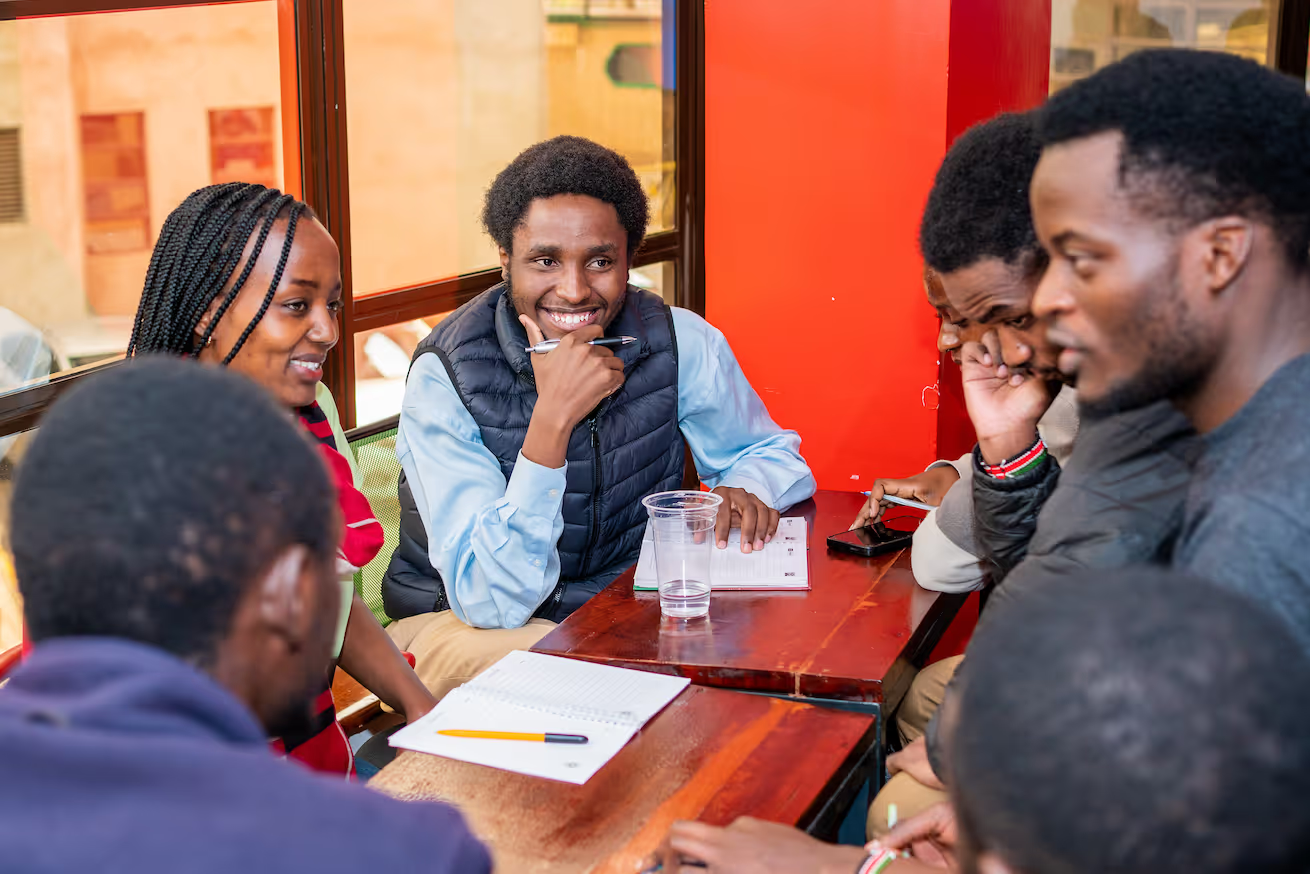
Group of young adults sitting around a table indoors, engaged in discussion with notebooks and a smartphone.
Collaboration is key. By working closely with local innovators, therapists, and persons with speech impairments, we can co-create AI solutions that recognise and respond to speech in local languages
Dr. Richard Cave

People

Prof. Catherine Holloway
Co-Founder & Academic Director

Cathy is co-founder & Academic Director of GDI Hub and the Centre for Digital Language Inclusion. Cathy leads the Innovation Cluster and the Data and Evidence cluster of the flagship AT2030 programme. Cathy leads the innovation work of GDI hub, including the imagination and initiation of Innovate Now and the AT Impact Fund. Cathy contributed to the WHO-UNICEF Global Report on Assistive Technology as an author and via membership of the Expert Advisory Panel. Cathy currently sits on the EPSRC Strategic Advisory Team for Healthcare Technology, and the WHO Technical Advisory Group for Assistive Technology. At UCL, Cathy is Prof. Interaction Design & Innovation at the world-leading UCL Interaction Centre, led the design of the MSc Disability Design & Innovation and is co-Director of the WHO Collaborating Center on Assistive Technology. Cathy's team at UCL also develops novel technologies for disabled people in the UK and globally. It is currently investigating the role of future technologies, such as AI, haptics and mobile, in solving major global priorities of poverty and inclusion.

Visit Author Page
Dr Richard Cave smiling at the camera
Dr. Richard Cave
Co-Director, Centre for Digital Language Inclusion
Video introduction, filmed at UCL

Dr Richard Cave is the Co-director of the Centre for Digital Language Inclusion (CDLI) and a certified Speech and Language Therapist. His PhD and other research focuses on the lived experience of people living with speech change when using AI-driven speech recognition technology and how it may help them to be better understood in everyday conversation. Richard has 18 years clinical experience working with communities at risk of speech change and loss, including progressive, acquired and congenital conditions. He is a national advisor to Royal College of Speech and Language Therapist in the UK and recent recipient of the Allied Professional award from the International Alliance of ALS/Motor Neurone Disease. Between 2019-2024 Richard worked with Google Research on the Euphonia and Project Relate programs, focusing on speech recognition technology for those with 'non-standard' speech.

Visit Author Page
Ms. Gifty Ayoka
Lead Community Engagement, Africa

Gifty Ayoka is a dedicated speech and language therapist and CDLI’s lead of community engagement, Africa. She is also an assistant lecturer at the University of Health and Allied Sciences (UHAS), training the next generation of Ghana’s speech and language therapists. She brings extensive experience in working with both children and adults to enhance their communication abilities and improve their overall quality of life.
Her work is grounded in a deep commitment to inclusion, disability rights, and accessibility, especially within underrepresented communities. Gifty is a passionate advocate who strives to ensure that individuals with communication difficulties have equal opportunities to thrive. Her efforts span direct therapy, the development and application of technological solutions, and contributions to policy initiatives that promote communication equity. She is also a co-author of the research study titled “Enhancing Communication Equity: Evaluation of an Automated Speech Recognition Application in Ghana,” which explores innovative approaches to
improving communication accessibility.


Currently, Gifty is part of a pioneering research team collecting voice data from individuals with speech impairments/non-standard speech in diverse African languages. This important work aims to support the development of AI datasets in local languages.

Visit Author Page
Dr. Giulia Barbareschi
Lead Research

Dr Giulia is a Professor of Inclusive Technology and Collective Engagement at the Research Center Trustworthy Data Science and Security (UA Ruhr) and the Faculty of Informatics at the University of Duisburg Essen in Germany. The focus of my research is the design, development and evaluation of technology that addresses the needs and priorities of disabled individuals and other marginalized users in both the Global South and Global North to ensure more equitable access to opportunities.

Visit Author Page
Dr Katrin Tomanek
Dr. Katrin Tomanek
AI Tech Lead

Katrin is AI Tech Lead at GDIHub's Centre for Digital Language Inclusion, working to ensure that voice technology serves everyone, regardless of their speech patterns. Katrin holds a PhD in Computer Science from Technical University of Dortmund and has 15+ years of experience across academia and industry in both AI applications and applied research, including amongst others building the automated classification and keywording system for the German National Library’s electronic catalogue and the European Patent Office, Recommendation Systems at OpenTable, Neural Machine Translation at Google Translate, LLM steering at Google's Responsible AI Research team, and leading ASR research efforts on non-standard speech within Project Euphonia.

Visit Author Page
Brian Mwenda
CEO Hope Tech and Senses Hub

Brian Mwenda is the Founder and CEO of Hope Tech and Senses Hub. He has an engineering background building assistive technology for people with disabilities, with a focus on mobility and navigation for blind and visually impaired users.

He leads the development of The Sixth Sense, a wearable mobility and hazard-detection system that combines sensors, haptics, and audio feedback to support independent navigation. The product has been developed over several years through iterative engineering and user testing across the UK, Africa, Europe, and Australia.

Hope Tech operates in the UK, Kenya, and Austria, focusing on assistive technology research, product development, and distribution of the Sixth Sense mobility aid. Alongside this, Brian co-founded Senses Hub in Nairobi, a research, innovation and distribution company that supports the design, testing, and deployment of disability-focused technologies across Africa.

His work includes large-scale accessibility research, inclusive AI programs, and non-standard speech technology initiatives delivered in partnership with universities, governments, and disability organizations.

Brian is a Forbes Under 30 Europe 2025 honouree, an alumnus of the Royal Academy of Engineering’s Africa Prize for Engineering Innovation, and an alumnus of Innovate Now by the Global Disability Innovation Hub.
Visit Author Page
Naomi Thompson
Head of Programmes

Naomi joined GDI Hub in 2020, bringing experience overseeing a portfolio of community and international development projects across east and southern Africa. Her role covers programme design, monitoring, learning and evaluation, portfolio coordination and stakeholder engagement. Naomi leads on the delivery of the AT2030 programme, and provides programme oversight across GDI Hub's portfolio, with responsibility for delivery quality, stakeholder coordination and team management.

Visit Author Page
Chintan
Chintan Ghate
Software Engineer

Chintan Ghate is a software engineer and researcher based in Vadodara, India, working at the intersection of accessible technology, digital healthcare, and user-centric design. During his tenure at Google, he contributed to healthcare research projects on multiple sclerosis and maternal health, and worked on speech accessibility through Project Relate. At CDLI he is currently focused on improving speech recognition for dysarthric speakers through his work on Project Euphonia.

Visit Author Page

LEd by

CDLI partners with a number of organisations globally and locally to fulfill our mission. For information about our partnerships, click on the cards below:

Lorem ipsum dolor sit amet, consectetur adipiscing elit, sed do eiusmod tempor incididunt ut labore et dolore magna aliqua. Ut enim ad minim veniam, quis nostrud exercitation ullamco laboris nisi ut aliquip ex ea commodo consequat. Duis aute irure dolor in reprehenderit in voluptate velit esse cillum dolore eu fugiat nulla pariatur. Excepteur sint occaecat cupidatat non proident, sunt in culpa qui officia deserunt mollit anim id est laborum.

Visit Site

Global Disability Innovation (GDI) Hub accelerates ideas into impact for a more just world - for disabled people and all people. We are a world leading delivery and practice centre, an Academic Research Centre at UCL (University College London), and the first WHO Global Collaborating Centre on Assistive Technology (AT). Operational in over 60 countries, we work with more than 70 partners through our AT2030 programme, delivering projects across a portfolio of £50m. GDI Hub has reached 64 million people since its launch in 2016 by developing bold approaches, building innovative partnerships, and creating ecosystems to accelerate change.

Visit Site

AT2030 explores and tests innovative ways to address systematic challenges to get more AT to the people that need it. From creating deep community leadership to generating new evidence & insights, we answer critical research questions and develop foundational methodologies, addressing intersectional challenges and research and evidence gaps. From incubating future tech-inspired solutions to venture acceleration, we bring effective solutions to market by testing new mechanisms and ambitious scaling pathways. We embed disability innovation into national policy landscapes, stimulating demand, activating country pilots, strengthening systems, and creating enabling market environments in low- and middle-income countries. We've reached 10 million people directly and over 64 million in total, working with over 150 partners in over 50 countries.

Visit Site

Lorem ipsum dolor sit amet, consectetur adipiscing elit, sed do eiusmod tempor incididunt ut labore et dolore magna aliqua. Ut enim ad minim veniam, quis nostrud exercitation ullamco laboris nisi ut aliquip ex ea commodo consequat. Duis aute irure dolor in reprehenderit in voluptate velit esse cillum dolore eu fugiat nulla pariatur. Excepteur sint occaecat cupidatat non proident, sunt in culpa qui officia deserunt mollit anim id est laborum.

Visit Site

in Partnership with

Google.org is a key partner in the Centre for Digital Language Inclusion, providing both funding and technical expertise to expand our work across African languages. Through this collaboration, Google Research scientists work directly with our team and University of Ghana researchers, offering training, cloud computing resources, and insights from their Project Euphonia research on non-standard speech recognition. Building on Google's established work in language inclusion, this partnership enables us to create open-source datasets and ASR models that make communication technology accessible to non-English-speaking populations across Africa, particularly those with non-standard speech who have historically had the least access to assistive technology.

Visit Site

Collaborators

Talking Tipps Africa was founded from a personal journey to secure inclusive education and communication support for the Founder’s child on the Autism spectrum. Confronted with systemic barriers faced by families of children with disabilities, the organization was established to bridge gaps in communication resources and promote inclusion across Africa.

Since its inception, Talking Tipps Africa has engaged key government ministries and collaborated with international partners such as the Global Disability Innovation Hub (GDI Hub). One of the major impactful work has been collaborating with Center for Digital Language Inclusion to collect  impaired speech data on local languages to transform AI data sets making it inclusive .Its growth has been marked by initiatives including the Read2Baby Campaign, the Zero2Five Conference, and the training of caregivers and professionals. A major milestone was co-authoring research on the use of Automatic Speech Recognition to improve communication access in the Global South.

Today, Talking Tipps Africa continues to drive advocacy, research, and community-based action, advancing the rights and inclusion of persons with communication disabilities, particularly across Ghana.

Visit Site

Established in 2023, Senses Hub is the brainchild of Hope Tech, a pioneering assistive technology development company, and a collective of passionate individuals dedicated to fostering an inclusive society. At Senses Hub, our mission is to break down barriers, challenge the status quo, and pave the way for inclusivity and accessibility for all. Through innovative assistive technologies and advocacy, we empower persons with disabilities to achieve their fullest potential and live their lives with independence.

Visit Site

Lorem ipsum dolor sit amet, consectetur adipiscing elit, sed do eiusmod tempor incididunt ut labore et dolore magna aliqua. Ut enim ad minim veniam, quis nostrud exercitation ullamco laboris nisi ut aliquip ex ea commodo consequat. Duis aute irure dolor in reprehenderit in voluptate velit esse cillum dolore eu fugiat nulla pariatur. Excepteur sint occaecat cupidatat non proident, sunt in culpa qui officia deserunt mollit anim id est laborum.

Visit Site

The Keio University Graduate School of Media Design (KMD) addresses real-world challenges while envisioning optimal futures. Our mission is to pioneer "media design" – creating new connections between people and their environments – while developing "media innovators" who transcend traditional disciplinary and national boundaries.

Visit Site